UX research · Conceptual
London Libraries - A Kiosk for the People Left Behind
Weekly free events at Woolwich Library were invisible to most visitors. I led end-to-end research and designed an interactive kiosk system to fix the discoverability problem - validated with real users on site.
Role
Project Manager · UX Researcher · Interaction Designer
timeline
2 Months
team
4 People
industry
Public sector / Cultural
The PRoblem
The events existed. Nobody knew about them.
Woolwich Library hosted dozens of free weekly events for its community, but had no effective system for letting visitors know they existed. People were leaving the library without any awareness of the programmes available to them. The problem wasn't the offer. It was the complete absence of discoverability, and the people most likely to benefit from the events were the least likely to find out about them.
The approach
Research in the field. Design from reality.
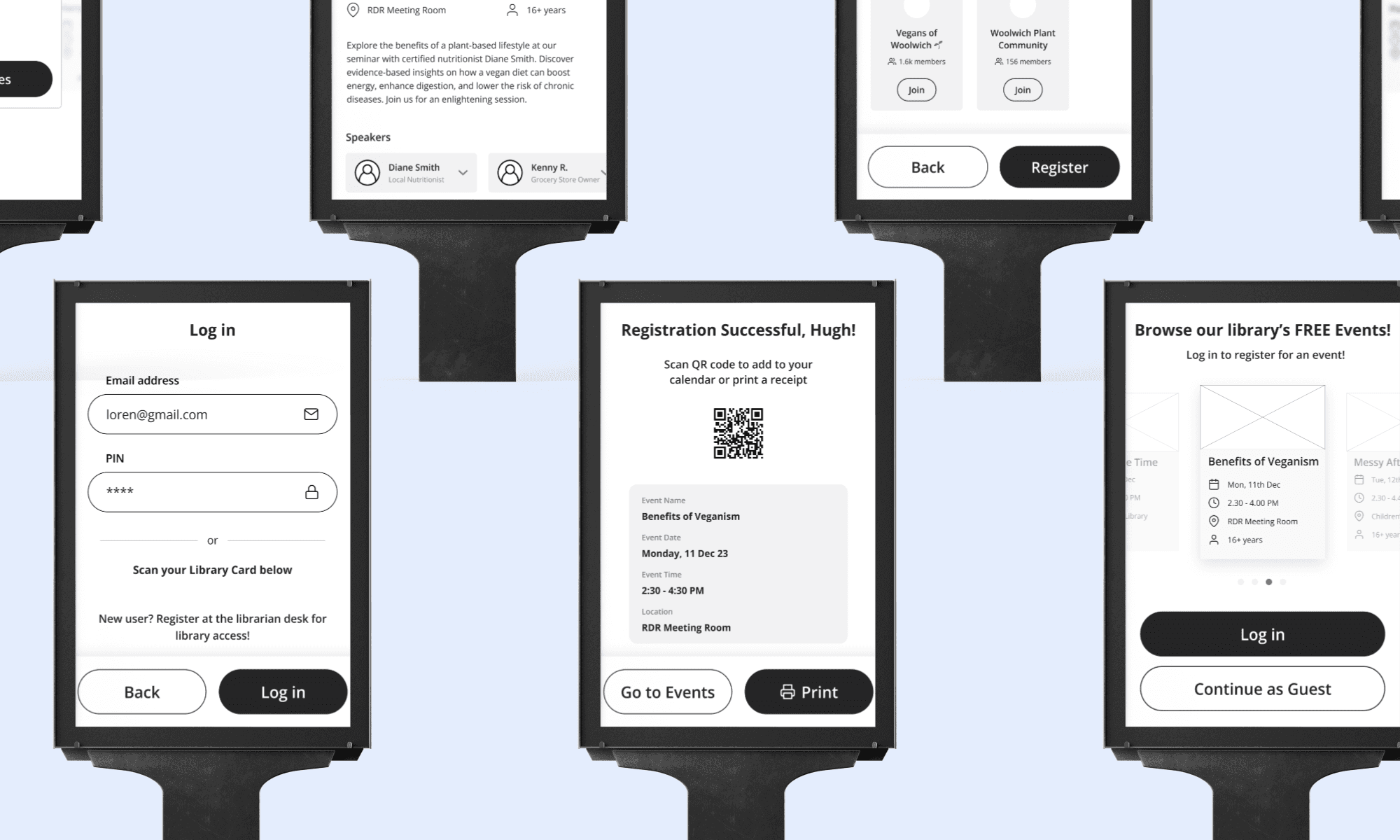
My team and I began with secondary research on the Woolwich demographic, then conducted in-person observation sessions and individual interviews at the library itself, speaking to real visitors about their habits, needs, and relationship with the library's services. Personas and user journey maps were developed from this fieldwork. Three rounds of wireframe iteration followed, each refined by expert peer review. A critical insight emerged during prototype testing: a screen-based prototype on a laptop could not replicate the scale of a kiosk. So we pivoted to paper prototyping, which allowed us to test at realistic proportions and gather far more valid responses from participants.
The outcome
Validated on site. Intuitive across age groups.
Paper prototype testing with real library visitors confirmed the concept was intuitive across age groups, including older visitors with low digital confidence, exactly the demographic most likely to benefit from the events programme. Task completion was achieved without instruction on first attempt. The pivot to paper prototyping was a key methodological learning I now apply to every project involving physical or large-format interfaces.
The tools
This are some of the tools I used in this project.
Figma
Notion
Miro
slack
The team approached the project with real rigour, they actually came to the library, spoke to our visitors, and designed something that made sense for our community.